Well, my desire to lose a few kilos prior to the arrival of my new frame isn't going very well. If you recall, my plan was to quit drinking. Period. This lasted for more than two weeks, which was great, but effected zero change in my weight. It was also impossible to maintain this abstemiousness because, frankly, I live in the Land of Drink. Drinking here is an important - even vital - social lubricant. So, giving it up completely isn't an option, I've decided to avoid beer altogether, as well as the canned super-sweet cocktails called Chu-Hi, and stick to plain old wine. At least that has polyphenols and only 506 calories to a 750ml bottle of white wine and 638 to a bottle of red (according to a reliable source!).
Of course, Brian and I are fairly (though not overly) active. We ride our single speeds several times a week (always uphill, with very little down involved or so it seems), and are fortunate enough to be able to ride either before or after work when we so choose. But we have become less adventurous recently and rarely (never?) night ride anymore. I think the new frame will invigorate me at least and I'll insist that we charge up our super-awesome night lights (Cateye Double-Shots) and head up to the Fireroad one of these fine summer evenings. Of course, we'll have to bring a victory beer (or small bottle of wine, in my case), to enjoy at the top of the mountain!
Tuesday, July 22, 2008

Clockwork 29er Frame - nearly there
This was a long weekend for us since yesterday was Umi-no-Hi - a "celebrate the ocean" day. The weather wasn't quite fine enough for us to hit the beach, but we did plenty of riding this weekend and I got another update from Joel: my frame is done, all it needs now is paint.


Friday, July 18, 2008
The Book I Couldn't Finish
Book people I know (and, uh...the Internet) are abuzz about a book about a girl who spends a self-centred but non-introspective year abroad performing a "self-enquiry". Eat, Pray, Love by Elizabeth Gilbert has been on the New York Times Best Seller list for a year and a half already, and has received rave reviews. I, however, have not been able to get past page 30.
The author comes across as a naive, spoiled, superficial whiny little brat. I cannot criticize further because, as I said, I did not get past page 30. In my youth, I would have felt guilty about not finishing a book. In my aged wisdom, I realize that I'd rather not throw in good time with the bad, on top of the cash already laid out for the tripe that passes for "good reading". As I said, though - most people seem to love this book. It's just really not for me. And so I've given the book away, to someone who can perhaps appreciate it.
The author comes across as a naive, spoiled, superficial whiny little brat. I cannot criticize further because, as I said, I did not get past page 30. In my youth, I would have felt guilty about not finishing a book. In my aged wisdom, I realize that I'd rather not throw in good time with the bad, on top of the cash already laid out for the tripe that passes for "good reading". As I said, though - most people seem to love this book. It's just really not for me. And so I've given the book away, to someone who can perhaps appreciate it.
Thursday, July 17, 2008
Finding Zazen
Being in the land of Zen, one would think it would be easy to find places to practise and to meditate - and it is pretty easy. Deciding to finally stop being lazy, I did a search (at yahoo.co.jp) and I found a temple not far from where we live that has zazen kai every Saturday and Sunday morning. I called the temple to confirm the times and let the monk know that I'd drop in.
The following Sunday morning I got an early start to the temple and I arrived as another person was just entering. This was useful because I was pretty much lost about where to go. He showed me to the zendo, where meditation had already begun, and showed me where to get my zabuton (floor cushion). We then quietly sat, joining two other people and the monk. Shortly afterwards, we began to do some chants, then did some walking zen, walking around the zendo.
At six-thirty, about six more people came and we took a break from meditating in order to...do some stretching exercises which are called "rajio (Radio) taiso" because the are generally done following instructions from the radio (or CD, or even TV). Here is a video from You Tube if you'd like to get a clearer picture:
Radio taiso is very commonly done in offices every morning throughout Japan, but I did not expect to find it at the Zen temple! Of course, I joined in although, not ever having actually done taiso before, I was always a step behind.
Like so many things in Japan, the zazen kai is really a chance to be social and show a sense of community, and so after our meditating and chanting, we all helped clean the temple – sweeping, dusting, and vacuuming – before congregating in the “tea room” for some o-kayu (soupy rice), tea, and watermelon. Again, all the participants helped set the table, cut the watermelon and clean the dishes. There were eight of us in total. Oh - this temple is rather small and caters to the local people, so naturally I was the only foreigner. However, I was made to feel very welcome, and the monk even sent me an English "How to Do Zazen" pamphlet in the mail.
I think I would have gone back last weekend, but the fine summer weather and easy access to a nice sandy beach kept me away. However, I do plan to go again.
If you want to find a temple that has English help/guidance, check out this page:
http://www.sotozen-net.or.jp/kokusai/list.htm
If you're comfortable in Japanese and want to find something a bit closer to you, check out this page:
http://www.sotozen-net.or.jp/
Wednesday, July 16, 2008
More Bike Pics
I know, it's been a long while since my last post. I have no excuse except to say that there is no Internet at the beach! I was also away on business in Tokyo (the Big Toe!).
Anyway, more updates from Joel Greenblatt - my bike is really coming along:
This is just the bottom bracket:

But here's where you can really see the bike taking shape:
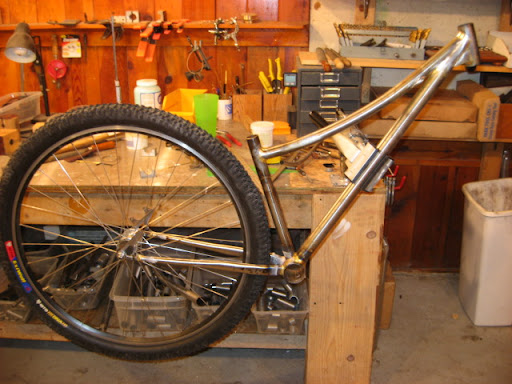
Anyway, more updates from Joel Greenblatt - my bike is really coming along:
This is just the bottom bracket:
But here's where you can really see the bike taking shape:
Tuesday, July 08, 2008
Riding in the Rain
Have you ever done something after you haven't done it for a while? Something that you really used to enjoy? You avoid doing it, don't feel the desire for it. The passion's gone...but then you do that thing again, and while you're fully caught up in the joy of that thing, all you can think is, "I'd forgotten!" And you're amazed, because how could you ever forget joy like this?
This occasionally happens to me when I ride. It used to happen every year back in Montreal when I would get out for my first night ride after the thaw - the weather still crisp and the streets damp, the smell of fresh earth permeating the air as I pedalled along the river at speeds as high as I could manage on my road bike. Now, I get that feeling in the rain.
It had been a long time - maybe even two years - since our passion for riding led us out in the driving rain. This morning we had decided to ride, rain or shine. It's rainy season, so if we didn't ride anyway, we'd only be riding once a week if we were lucky. So out we went to brave the elements. Not long after we got out of the city and into the hills, pedalling at a leisurely pace, I remembered that I'd forgotten; forgotten how sublime everything could become when stifled by the rain, how the trees were greener, the streets quieter - so quiet that you can, briefly, imagine that you alone exist here. Nobody goes out in the rain at 6 a.m., you see, except, apparently, a couple of crazy bikers.
Monday, July 07, 2008
Pay to Pet the Dogs
Finally, rainy season took a short break and we had great weekend summer weather. Not wanting to miss out on the first bit of sunshine we’ve had in the last month and a half, we got out for a long bike ride on Saturday morning, finishing up at our favourite beer garden!
We were pleasantly surprised to see that it wasn’t very busy and we had our pick of the picnic tables in the sun, where we promptly sat to drink a few pints of German brew.

As we sat, we got to entertain ourselves watching some “therapy” dogs in a pen. These dogs were here, brought by some company or organization, in order to earn money by being petted. They’re called “therapy dogs” because, I suppose, petting the dogs is considered therapeutic. It was 500 yen for adults to enter the pen, and 300 yen for children. Though we’re both dog lovers, we find this a bit kitschy (and also suspected that the dogs had been sedated!) and opted to spend our cash instead on another pint of beer!


Thursday, July 03, 2008
Engakuji: Revisiting Suzuki Daisetsu
A couple of weekends ago - on June 21 - Brian and I spent a (very organized) day in Kamakura as part of the "Kokoro-Juku". I'd first read about the event, organized by the Public Art Research Institute, in the Japan Times newspaper (see the original article here at http://search.japantimes.co.jp/cgi-bin/nn20080603f1.html).It sounded like a fun cultural day out, so I contacted Sugimura-san, and signed both of us up for the day.
The plan was to meet at main gate Engakuji, one of the famous five temples in Kamakura, and begin the day at 9:30 with a speech on public manners and Bushido (the way of the Samurai) by 75-year old Sugimura-san. I figured this would be a controversial discussion, and was looking forward to the day. My greatest fear was that this was going to be a day spent with other foreigners (like me and Brian); actually, though, out of the 24 participants, there were very few foreigners: me, Brian, two Chinese who were fluent in Japanese, and one Romanian guy who actually carried a knife and fork in his bag; he didn't even try to use chopsticks, even when we were dining on Shojin ryori (see later)! I was also delighted to discover that the entire day was conducted in Japanese - which was as it should be, and it was good listening practice, too.
The day began in one nice tatami room in the main temple with Sugimura-san's speech. However, contrary to controversial, the smiley man talked first about the newspaper article (noted above), and the publicity. Then he quoted a few un-controversial excerpts from D.T.Suzuki's Zen and Japanese Culture (which is a great book!), and, perhaps not wanting to disturb the wa, did not at all analyze or pontificate on the book. This was actually ok with us, and the group then proceeded on a tour of Engakuji, one of the famous five temples of Kamakura. One of the zen monks was our personal guide and we were permitted to actually enter the temple buildings proper while the lesser riff-raff just had to take photos from outside! We then had a nice bento-lunch before going to Tokeiji, where we were given a tour of Suzuki's home and library.
Following this, we did a zazen-kai (sitting meditation), with a large group of people. It was the rinzai zen, so we actually chanted, reading from our book of koans.
The tour and everything after was really enjoyable, of course, but even more so because the Japanese participants, at first reserved, began to strike up conversations with us as we walked around. Of course, once outside, Brian and I did not stick totally together, but allowed ourselves to become separate, which, I have to say, makes foreigners more approachable than when they're "travelling in packs".
The totally best part of the whole event had to be when we all went to the Hachinoki restaurant to savour Shojin Ryori, which is the very traditional and purely vegetarian food of Buddhist monks (The phone number for Hachinoki in Kita-Kamakura is 0120-23-3722). We again had a great chance to mingle, and, because (of course!) the sake was flowing generously, everyone loosened up and had a great time.
Oh - I should mention that twice on this day - once after zazen, and again after dinner, everyone had to do a little self-introduction (jiko-shoukai). If you really want to test your bravado, try giving a speech in Japanese in front of 23 strangers!
Here are a bunch of pics from the day:
Cemetary and a temple at Engakuji:

You will often see offerings on grave stones, and nearly as often, these offerings are beer, sake or another alcoholic beverage. Below, it's a bottle of sparkling wine. I should be so lucky.

These two were taken inside one of the temple buildings at Engakuji:


Shrine to Daisetsu Suzuki:

Suzuki's library:

In this season, Kamakura is famous for its ajisai (hydrangea):

Always in tune with the season, our dinner consisted of special tofu - Ajisai-dofu:

A fine selection of other vegetarian fare:

Of course, the sake was not too far behind. This is Nigori-zake, a very traditional sweet sake, being served from a special bowl:

We spent the night in Kamakura, and the next morning we walked to Hase Shrine, where we got this shot of ema (wooden prayer plaques) reflected in water:

Where to stay in Kamakura:
Yamakawa minshuku, near Yuigahama station. Tel: (0467)22-0783
For a map, click here: http://reserve.4travel.jp/domestic/hotel/each/10042018/map/
Japanese only, but very foreigner friendly, so easy to communicate.
There are sooooo many places to stay in or around Kamakura. We booked late, and because of the ajisai blooming it was tough to find a place. However, once again, we lucked out. I found the Yamakawa Minshuku, which is just two short stops on the Enoden line from Kamakura station (actually, you can even walk from Kamakura station!). The location was great, the room was small but really quiet, the proprietress was delightfully talkative and friendly, the (Japanese) breakfast was delicious and the price was right: just 5,600 yen per person including breakfast (expect 6,700 or so for dinner and breakfast). If shared showers/bathrooms bother you, and if you need everything to be spic and span, you should seek elsewhere. We, however, will be staying here again!
Wednesday, July 02, 2008
Maki-Zushi, take 2 - The Result
We still had some tuna left, so we made sushi again for dinner, and the second try resulted in slightly better rolls:


Tuesday, July 01, 2008
Making Maki Zushi
As one would expect, sushi of all types is very easy to come by around here. Whether you want nigiri-zushi, chirashi-zushi or, my personal favourite, maki-zushi, we can always find it already made at our local supermarket. It's fairly fresh and affordable, and takes no time at all (for me) to prepare. So why bother making our own maki-zushi? That was the question I always posed to myself, so, even after ten years in Japan, I had never made my own sushi.
Last weekend, though, I felt inspired, and I bought my first makisu (bamboo sushi rolling mat). Like sushi itself, these can be found at just about any shop or supermarket and cost less than $2. Then last night I bought the ingredients - some sashimi quality tuna, a few shiso leaves, and nori sheets. I already had cucumbers, soy sauce, and wasabi on hand.
I made my sushi rice (by adding a bit of rice vinegar and sugar to the cooked rice), then tried my first sushi roll:

The rolls were not perfect, but the sushi was really good. The shiso really added a special flavour, and we both felt that it tasted better than the store-bought sushi: probably fresher, and at the right temperature.
Subscribe to:
Posts (Atom)